Table of Contents
- Catholic Schools and SEL / Mental Health
- CASEL Model and Faith
- Catholic CASEL model
- Framework to Formation
- Additional Catholic Mental Health and SEL Development for Educators
Mental health and social-emotional learning (SEL) are increasingly important topics in American education institutions, and Catholic schools are no exception.
Pope Leo, in his first papal encyclical Magnifica Humanitas, reminds us of the call to care for the entire student, and not just his or her academic pursuits–a challenge made more challenging and confusing in the rapidly evolving AI era.
“The advance of information technologies and AI is rapidly rendering curricula obsolete that were designed for a different era. Meanwhile, the organization of schools, physical spaces, evaluation methods and the role of teachers themselves must be rethought in order to promote an authentically integral education that addresses every dimension of the person.”
Bishop John Dolan, the Bishop of Phoenix, echoed this sentiment in a piece he published on June 1, 2026, following a meeting with Pope Leo in Vatican City.
“As Catholics, we believe every person possesses an inherent dignity that can never be reduced to an algorithm, that education must form both minds and hearts and that technology must serve humanity rather than define it,” he said.
One of the challenges of structuring a program to ensure that students’ social and emotional learning needs (in addition to their academic needs) are met is that most SEL frameworks rely on completely secular language and assumptions.
That doesn’t quite fit when Catholic schools have missions that are anything but.
Here’s how to structure a Catholic social and emotional learning framework with real world examples.
Can Catholic Schools Use SEL?
Even if they lack the fundamental piece of Catholic education–faith–or a Scriptural foundation, secular frameworks can be helpful and there is a good deal that Catholic educators can draw from them.
And they are not necessarily at odds with each other.
In fact, through an NCEA webinar, researchers from DePaul University argued that faith and social-emotional learning are “intrinsically united.”
“Our faith is also a driver of us being able to achieve emotional competency within that social-emotional realm.”
James M. Frabutt, in his book Beyond Academics: Supporting the Mental, Emotional, and Behavioral Health of Students in Catholic Schools, writes that “Making sure that children’s nonacademic needs are met in Catholic schools should not be optional.”
Where does care of the entire person come from? Scripture, beginning with Genesis, where we are reminded that we’re created in God’s image.
“This notion of human worth being a God-given reality and not a human-earned award is the foundation of many civic and social claims to human dignity and the inherent rights of all people,” writes Frabutt.
In thinking of an SEL model for Catholic educators, faith must be central and inform every component of the framework, since caring for the non-academic needs of students reflects our belief that we are created in God’s likeness.
The CASEL Model with Catholic Identity at the Center
What does it look like when we put faith at the center of an SEL model?
Most educators are at least somewhat familiar with CASEL – the Collaborative for Academic, Social and Emotional Learning, and its five-pillar framework:
- Self-Awareness
- Self-Management
- Responsible Decision-making
- Social Awareness
- Relationship Skills
In the form of a chart, placing Catholic identity as the central piece of the paradigm looks something like this:
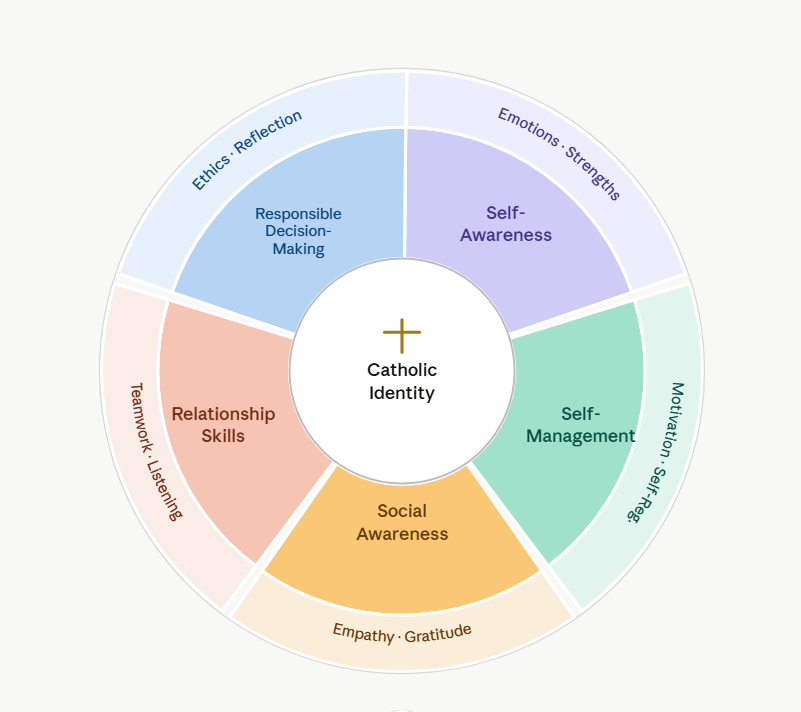
For Catholic educators and students, our faith is central to all of these pillars. And as we explore them, we realize that they are all rooted in our faith:
- Self-Awareness: Genesis story, made in God’s image
- Self-Management: self-control, discipline..: fruits of the spirit
- Responsible Decision-Making: Christian ethics
- Social Awareness: Golden Rule: Catholic Social Teaching
- Relationship Skills: How to apologize (confession)
CASEL but Catholic
Taking this a step further, Catholic educators can utilize a framework that is rooted in CASEL’s structure but is distinctly Catholic.
The DePaul researchers sharing insights in the NCEA panel framed the CASEL model through the lens of Catholic faith and Catholic Social Teaching:
- Purpose (Faith and Self-awareness)
- Passion (Faithful purpose and self-management)
- Perspective (Faith and relationship through empathy)
- Presence (Faith and responsible decision-making)
- Practices (Faith and social awareness and action)
Overlaid over the traditional CASEL framework, the Catholic model would look like this chart, designed by Hallow:
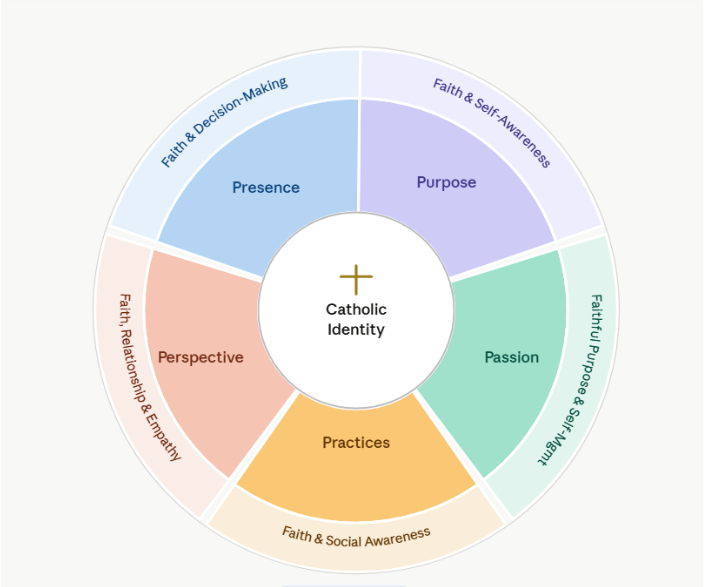
It respects the entire person as in secular social-emotional models.
But is entirely Catholic.
Resources on Hallow can help bring this framework to life for students of all ages:
Purpose (Faith and Self-awareness)
Bible stories help children understand their identity rooted in Scripture–and God’s image.
Passion (Faithful purpose and self-management)
There are no better examples of purpose, passion and self-management than the lives of the saints.
Perspective (Faith and relationship through empathy)
Hallow has guides for the sacrament of reconciliation for different age groups, as well as prayers for the classroom to help students develop better relationships with both God and their peers.
Presence (Faith and responsible decision-making)
Practices (Faith and social awareness and action)
If you’re getting started with Social-Emotional Learning, mapping your existing practices to these five pillars can help bring into focus gaps you may need to prioritize.
From Framework to Formation
At the 2022 NCEA conference, Joneil Galey, M.ED., NCC, LPC from Brother Martin High School (New Orleans) peeled back the curtain on the tactics they employ to foster social and emotional learning. Christine Gibson from Christ the King School in Lexington, Ky., shared similar ideas for K-8 schools in an NCEA webinar in 2023.
Both shared a wealth of concrete examples helpful for thinking about SEL in Catholic schools. Here are some helpful ideas, both at the institutional and classroom levels, mapped out to the five pillars of the Catholic CASEL framework described above:
Purpose (Faith and Self-Awareness)
- Grade-Level Retreats
- I Don’t Want to Be a Frog – Recognizing God made us each unique and accepting who God has created us to be
- Sophomore Reflection Interviews – Task students with reflecting on what their expectations were entering high school, where they are now, and where are they heading.
- Student Self-Assessments / Behavioral Self-Assessments – Challenging students to reflect on their own behavior and progress
Passion (Faithful Purpose and Self-Management)
- Dedicated Wellness Center / Self-Regulation Space
- Wilma Jean the Worry Machine – Discussing peace that comes from God and that we can turn worries over to God
- “What If?” Exercises – Working with young students to explore “What if” scenarios, positive and negative, to explore topics of anxiousness and worry, and Bible verses relevant to those topics.
- Executive Functioning Instruction
- Summer Enrichment Programs
- Study Skills and Test Preparation Programs
Perspective (Faith and Relationship Through Empathy)
Hallow has guides for the sacrament of reconciliation for different age groups, as well as prayers for the classroom to help students develop better relationships with both God and their peers.
- A Boy and a Jaguar – Lessons in empathy and appreciating differences
- Student presentations on areas of difference, i.e., older student with hearing aids explaining how they work to younger students
- Faculty Mentor Program
- Student Minister Religion Visits
- Summer Enrichment Community-Building Activities
Presence (Faith and Responsible Decision-Making)
- Say Something – Helping younger children develop the confidence to speak up if evil is happening around them
- Just Kidding – Tying back to Bible verses related to kindness and building each other up
- Reflecting on sins of omission
- Speaker Sessions (Drunk and Distracted Driving Program)
- College Day and Career Day
- Discipline Recovery Program – a program that aids students with unique situations and attendance issues to help them get back on track. The school has a philosophy of “friendly discipline” that corrects but also “teaches and encourages.”
Practices (Faith and Social Awareness and Action)
- Ordinary Mary’s Extraordinary Deed – A story of how good deeds can have a positive ripple effect (which was a central theme of Hallow’s 2026 Lent Pray40 prayer challenge!)
- Student Service Hours
- Student Leadership Opportunities in Ministry/Liturgy
- Service-Oriented School Activities
Additional Catholic Mental Health and SEL Development for Educators
One helpful resource for adults on social and emotional learning through a Catholic lens is Insight, a video series produced by the Institute for the Transformation of Catholic Education at the Catholic University of America and Aquinas College in Nashville.
The series includes 10 sessions that explore topics like understanding emotions, looking for the good in everyone, and effective communication all from a Catholic worldview.
Insight is free and is a great resource for educators looking to dive into SEL or learn more about how it can be rooted in Catholic teaching.
The program also includes a prayer companion that includes meditations on sacred art and scripture.
How Hallow Can Help
Hallow partners with thousands of schools and parishes around the country to support the faith journey of young people at all stages of their education.
Content inside the Hallow app touches all five CASEL pillars and can be a major asset for teachers looking for new ways to engage their students.
Learn more by speaking with a Hallow team member today.