Hallow data shows rise in OCIA, other Catholic ministries at colleges and universities around the country
CHICAGO, Aug. 19, 2026 – The fall semester at USC doesn’t begin officially until Aug. 24, but Deacon Paul Pesqueira is already preparing for what could be his busiest year yet.
Pesqueira has overseen the OCIA program at the USC Caruso Catholic Center for 14 years. In 2023-24, 18 students participated in the program. The following year, that number jumped to 25.
Heading into the 2025-26 school year, Pesqueira simply wanted to keep the growth trend positive.
“I wanted 26. God, in His infinite wisdom, mercy and generosity, gave me 44 students,” he said.
That marked a 76% increase in a single year, all without advertising the OCIA program.
“All of this has happened at USC with zero marketing. Nothing,” he said. “Always word of mouth.”
USC is far from alone. The school is part of a broader national trend of college-age people entering and returning to the Church.
Hallow obtained OCIA data from nearly 60 colleges and universities across the country and found a widespread increase in not only young adults entering the Catholic Church, but Catholic ministries of all sorts gaining popularity.
Catholicism Surging on College Campuses
On campuses of various sizes, all across the United States, Catholicism is on the rise.
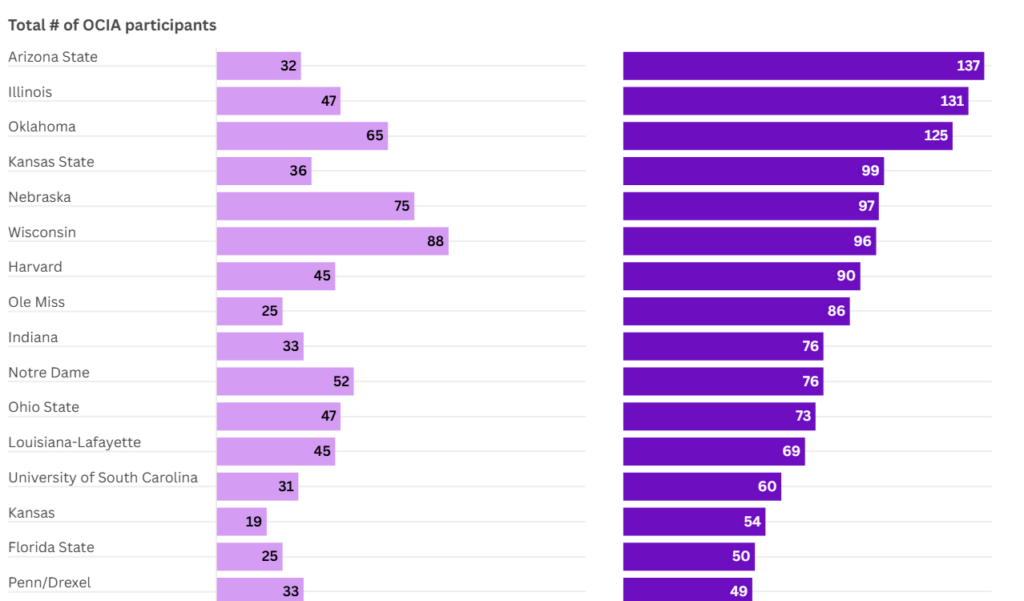
Among the schools reporting data to Hallow, OCIA participation on average more than doubled (+115% growth) from the 2024-25 school year to 2025-26.
Looking at the data in aggregate, by comparing the total number of participants across all Newman Centers in the data set in 2024-25 with the total in 2025-26, OCIA participation increased 87.6%.
Some of the schools with the largest overall OCIA numbers from the 2025-26 school year include:
- Arizona State University: 137 (combined candidates and catechumens)
- University of Illinois: 131
- University of Oklahoma: 125
- Kansas State University: 99
- University of Nebraska: 97
- University of Wisconsin: 96
- Harvard University: 90
Several schools that reported little or no OCIA participation in 2024-25 saw new candidates and catechumens in 2025-26:
- Ursuline College (Pepper Pike, Ohio): 1 (0 in 2025)
- Bard College (Annandale-on-Hudson, N.Y.): 3 (0 in 2025)
- University of Louisville: 10 (1 in 2025)
Hallow released data earlier this year showing that on average, dioceses are up +38% in OCIA candidates and catechumens. The growth seen from Newman Centers and university parishes is outpacing that growth considerably; college-age young people may be entering the Church at a faster rate than the general American population.
And when they enter or return to the Church, they’re doing so with a fire that spreads across various ministries.
Rising Tide Across All Ministries
OCIA numbers are just part of the story of young people reignited in faith. The same ministries are seeing increased attendance at Mass, retreats, confession and Eucharistic adoration.
At St. Thomas More on the campus of the University of South Carolina, candidates and catechumens nearly doubled last year, but Katie Washington, Director of Development at St. Thomas, is seeing the wave of faith ripple across all of its ministries.
Daily Mass attendance rose from an average of 45 to 80 during the same time period and Sunday Mass attendance is also up.
In 2023, St. Thomas More welcomed 23 students on its fall retreat; in 2025, that number shot up to 122.
The 2021 Ash Wednesday services saw 500 students attend; by Ash Wednesday of this past year, 2,537 packed the church to receive ashes.
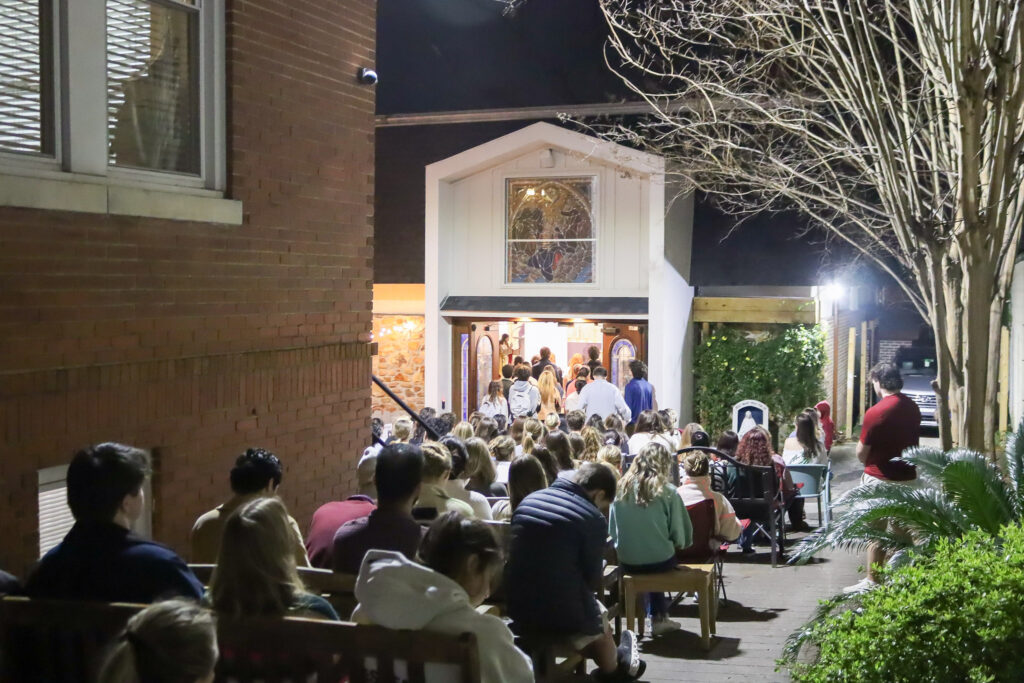
Washington believes the surge in interest in Catholicism on her campus reflects a desire students have for something deeper.
“Young people are hungry in faith,” she said.
It’s the same language that Hallow’s Rebekah Smith hears when she speaks to college and university partners.
She’s heard from campus ministers who have watched ministry meetings triple in size recently, who have held all-night Eucharistic adoration vigils, with some students staying the full 10 hours.
“Students keep telling us the same thing in different words: They’re hungry. They want to learn and grow,” she said. “It is an honor to come alongside partners across the country as students look to go deeper.”
Catholicism in the City
The growth isn’t confined to traditional college towns. Campus ministries in and around some of America’s largest cities are reporting similar increases.
USC, located in the University Park neighborhood of Los Angeles, saw a 76% increase in OCIA participation this past school year.
Further north, Stanford, located in the heart of Silicon Valley between San Jose and San Francisco, tripled its number of OCIA candidates and catechumens during the 2025-26 school year.
“When you consider baptisms alone, the number is more remarkable,” Fr. Bart Hutcherson, pastor of the Catholic Community at Stanford, said. “The average [number] of adult baptisms for 30 years is 4/year. I baptized 16 this Easter and they were almost all Stanford students!”
Across the country in New York City’s Greenwich Village, NYU saw an 88% increase in OCIA candidates and catechumens and its daily Mass attendance tripled.
Loyola University of Chicago saw its OCIA numbers double this past year with Mass attendance also growing in recent years.
Northwestern, in Evanston, Ill., a few miles north, is seeing the same momentum beyond OCIA.
“It’s one thing to hear about the resurgence of young people in the Church, but it’s another thing to experience it firsthand,” said Delaney Paul, the Director of Mission Impact & Donor Relations at Northwestern’s Sheil Catholic Center. “At the Sheil Catholic Center, we’ve witnessed remarkable growth not only in Mass attendance, but across every aspect of campus ministry.”
Paul said that retreats are overflowing, Sunday 5 p.m. Mass is packed nearly to capacity, and they’ve had to add additional opportunities for both confession and adoration.
“What is most encouraging isn’t just the numbers though, it’s the hunger our students have for Jesus and the way they so joyfully welcome others into our community. To see this happening at a secular university like Northwestern is incredibly hopeful.”
‘Conversion of Heart’
Among those college-age students who recently joined the Church is Sophia Carrenza, a student at Texas Christian University in Fort Worth, Texas.
Carrenza went through TCU’s OCIA program and now serves as a leader in the ministry.
She believes many college students have grown weary of societal pressures and expectations, much of it amplified by digital life.
“Unfortunately, my generation has become consumed with the digital aspects of life and feel constant societal pressures to be a certain way or to act a certain way,” she said. “But at some point, one realizes that isn’t enough, that it’s not all it was made out to be. So, they start asking questions and searching for answers, for meaning.”
Like other schools across the country, TCU has seen an increase in its OCIA numbers. Nine students are already registered for OCIA ahead of Easter 2027, and the TCU Catholic Campus Ministry is looking to create two Confirmation classes to accommodate the growing need.
She’s also noticed this resurgence in faith in ways that OCIA numbers can’t capture: renewed zeal among students who grew up Catholic but had fallen away from the faith.
“I have also come to realize that this conversion of heart is not only happening in those outside of the Church, but many cradle Catholics I’ve spoken with have experienced a reversion of sorts and become more involved and active in their faith as well,” she said.
The combined resurgence of those entering the Church and those returning to it is also reflected in TCU’s Mass attendance. Sunday Masses draw an average of 450 students at the private Christian university, which has an undergraduate enrollment of roughly 11,000.
The Holy Spirit at Work
Fr. Gabriel T. Mosher, OP, arrived at St. Catherine of Siena Catholic Newman Center at the University of Utah four years ago.
During that time, he’s seen Mass attendance at the Salt Lake City school triple, driven by a surge of young men, to whom Fr. Mosher believes the more monastic, Dominican-style liturgy particularly appeals.
“I don’t think liturgy is necessarily going to bring people to a parish, but it does cause people to stay,” he said.
Fr. Mosher recognizes the source of this resurgence: While Newman Centers and campus ministry teams work tirelessly, God is doing the heavy lifting.
“The Holy Spirit brings people to a parish. Christ effects conversion,” he said. “Christ infuses faith in people. We just have to be there to catch them.”
To report your school’s numbers, email diocesedata@hallow.app. To get free Hallow access for your OCIA participants on your campus, or to learn how Hallow supports Newman Centers, email university@hallow.app.